


 Cart
Cart
 sales@molnova.com



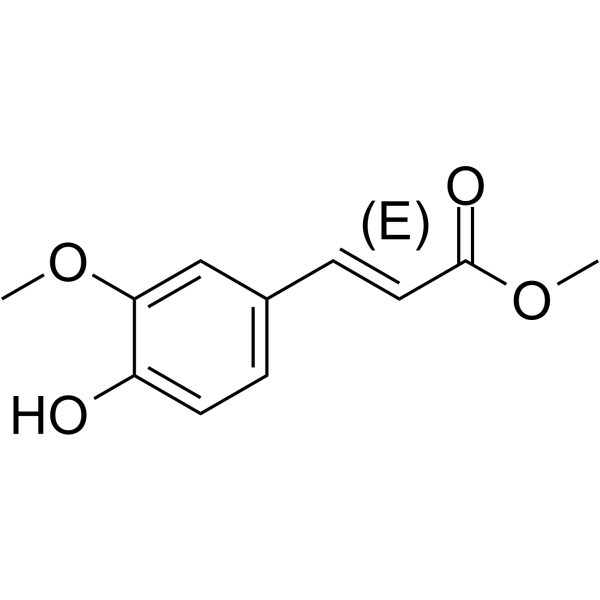
(E)-Ferulic acid methyl ester
CAS No. 22329-76-6
(E)-Ferulic acid methyl ester( Methyl (E)-ferulate | Methyl (E)-ferulate )
Catalog No. M28251 CAS No. 22329-76-6
Methyl (E)-ferulate is a possible inhibitor of the mitogen activated phosphor kinase pathway, it could be a potential anti-inflammatory agent isolated for the first time in medicinal plant S. tuberosa. Methyl (E)-ferulate has promising anthelmintic activity against Haemonchus contortus.
Purity : >98% (HPLC)
 COA
Datasheet
HNMR
HPLC
MSDS
Handing Instructions
COA
Datasheet
HNMR
HPLC
MSDS
Handing Instructions
| Size | Price / USD | Stock | Quantity |
| 5MG | 45 | In Stock |


|
| 10MG | 68 | In Stock |
|
| 25MG | 115 | In Stock |
|
| 50MG | 173 | In Stock |
|
| 100MG | 258 | In Stock |
|
| 200MG | Get Quote | In Stock |
|
| 500MG | Get Quote | In Stock |
|
| 1G | Get Quote | In Stock |
|
Biological Information
-
Product Name(E)-Ferulic acid methyl ester
-
NoteResearch use only, not for human use.
-
Brief DescriptionMethyl (E)-ferulate is a possible inhibitor of the mitogen activated phosphor kinase pathway, it could be a potential anti-inflammatory agent isolated for the first time in medicinal plant S. tuberosa. Methyl (E)-ferulate has promising anthelmintic activity against Haemonchus contortus.
-
DescriptionMethyl (E)-ferulate is a possible inhibitor of the mitogen activated phosphor kinase pathway, it could be a potential anti-inflammatory agent isolated for the first time in medicinal plant S. tuberosa. Methyl (E)-ferulate has promising anthelmintic activity against Haemonchus contortus.(In Vitro):The objective of this study is to evaluate the toxicity of Methyl ferulate (MF), methyl p-coumarate (MpC), and pulegone 1,2-epoxide (PE) with in vitro and in vivo assays. METHODS AND RESULTS:The in vitro toxicity of Methyl ferulate, MpC, and PE was assessed at a concentration of 10 mg/ml with the Ames assay using two strains of Salmonella typhimurium TA98 and TA100. Human red blood cells (RBC) were used to determine the hemolytic activity of these compounds. PE produced 6-8% hemolysis of RBCs at all the tested concentrations while Methyl ferulate and MpC produced 10-5% hemolysis up to 20 mg/ml, and 50-85% hemolysis at concentrations of 40 and 80 mg/ml, respectively. The Ames assay indicated that Methyl ferulate, MpC, and PE were non-mutagenic as the test values were not significantly higher as compared with background values of the assay. BSLB suggested the lethal concentration (LC50) values of Methyl ferulate, MpC, and PE as 4.38, 6.74, and 25.91 mg/ml, respectively. In vivo ocular and dermal irritation scores of Methyl ferulate, MpC, and PE were comparable with ethanol (control) in rabbits indicating the non-irritant nature of these natural compounds. CONCLUSIONS:The present studies suggest that these compounds are non-toxic/non-irritant and might be used for medicinal purposes.
-
In Vitro——
-
In Vivo——
-
SynonymsMethyl (E)-ferulate | Methyl (E)-ferulate
-
PathwayApoptosis
-
TargetIL Receptor
-
RecptorGluR1|GluR3|GluR5|AMPAR
-
Research Area——
-
Indication——
Chemical Information
-
CAS Number22329-76-6
-
Formula Weight208.21
-
Molecular FormulaC11H12O4
-
Purity>98% (HPLC)
-
Solubility——
-
SMILESCOC(/C=C/c(cc1)cc(OC)c1O)=O
-
Chemical Name——
Shipping & Storage Information
-
Storage(-20℃)
-
ShippingWith Ice Pack
-
Stability≥ 2 years
Reference
1.Poulsen MH, et al. Evaluation of PhTX-74 as subtype-selective inhibitor of GluA2-containing AMPA receptors. Mol Pharmacol. 2014 Feb;85(2):261-8.
molnova catalog



related products
-
Ganoderic acid A
Ganoderic acid A exhibits antitumor activity, mediated through its inhibitory effect on nuclear transcription factor-kappaB and activator protein-1.
-
IL-4-inhibitor-1
IL-4 inhibitor is an inhibitor of IL-4.1It binds to IL-4 with a Kdvalue of 1.8 μM and inhibits IL-4 activity in a cell-based reporter assay (EC50= 1.81 μM).
-
Mogroside IIe
Mogroside IIe is a major bioactive component of unripe S. grosvenorii fruit that downregulates the IL-9/IL-9 receptor pathway.
